
When you start comparing vasectomy reversal physicians, almost everyone quotes a “success rate.” The trouble is that the word “success” hides at least three different things, and a clinic can choose which one to advertise. A 95% figure and a 50% figure can both be honest, and both describe the same operation, because they are measuring different outcomes. This post explains what each number means, so you can read a success rate for what it actually says.
Three different finish lines
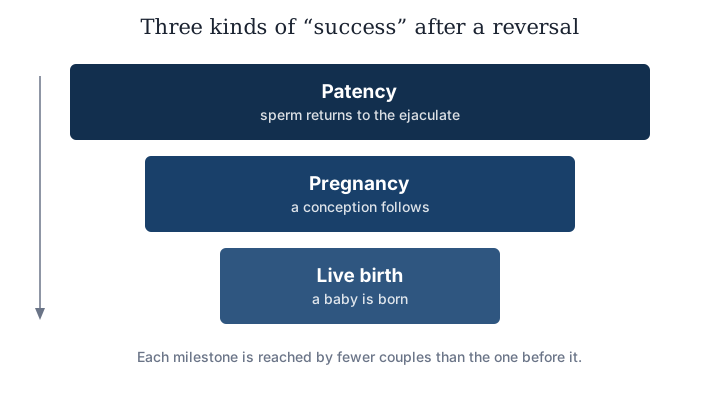
There are three milestones after a reversal, and they happen in sequence. Within the same group of patients, each one is reached by fewer men than the one before, since you cannot have a pregnancy without patency, or a live birth without a pregnancy.
Patency means sperm have returned to the ejaculate. It is confirmed by a laboratory semen analysis after surgery, not by how the operation looked on the day. Patency is the outcome most directly tied to the surgery, because it reflects whether the reconnection is working, though the interval since your vasectomy, the type of repair needed, and how the tissue heals all affect it too.
Pregnancy means a conception has occurred. It depends on patency, but also on your partner’s fertility, her age, how often and how long you try, and plain chance. A physician can do a technically excellent reversal and still see no pregnancy if there is a female-factor issue or simply not enough time has passed.
Live birth means a baby has been born. It sits below the pregnancy rate because not every pregnancy carries to term, mostly for the ordinary reasons that affect any pregnancy, the female partner’s age chief among them.
So a single reversal might show up as a patency success, a pregnancy success, and a live birth success all at once, or as a patency success that has not yet become a pregnancy. When you see one “success rate,” the first question worth asking is: success at which of these three things?
What the published numbers look like
Pooling the research makes the gap between these milestones concrete. A 2015 systematic review and meta-analysis of 31 studies and 6,633 men, all having microsurgical vasovasostomy (the most common type of reversal), reported an average patency rate of 89.4% and a pregnancy rate of 73.0%.1 A later review that also took in the more complex vasoepididymostomy reported average patency of 87% and average pregnancy of 49%, with pregnancy across the individual studies ranging from 22% to 68%.2 That is a wide spread for pregnancy, and it is not explained by surgical skill alone. It reflects how long each study followed couples, how old the female partners were, and who was included in the first place.
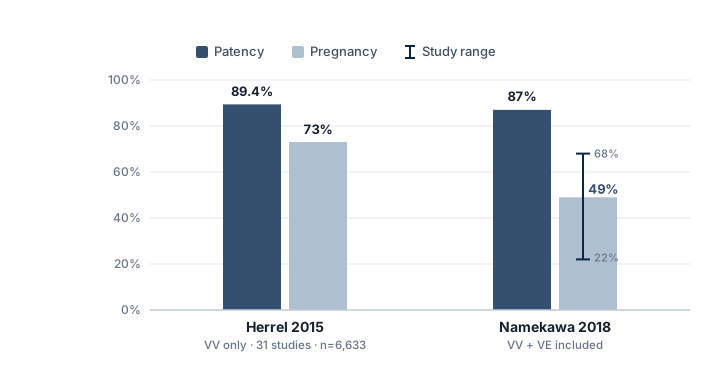
This is the core reason patency and pregnancy should never be quoted as if they were the same measure. Patency is usually reported in the high 80s to mid 90s across microsurgical series, though it still varies. Pregnancy rates swing much more widely, because most of what drives them happens outside the operating room.
Why patency is the number a physician should report
Patency is the fairest measure of the surgery itself, for a simple reason: it is the outcome that most closely reflects whether the reconstruction is working. Pregnancy and live birth are couple-level outcomes, so a physician who reports them is reflecting the partner’s fertility, the time a couple spends trying, and chance as much as the operation itself.
That cuts both ways when you read advertising. A very high pregnancy rate can reflect a practice that operates mainly on young couples with short intervals since vasectomy. A lower pregnancy rate can come from a physician who takes on harder cases, older partners, or longer obstructive intervals. Neither number tells you much on its own without knowing the denominator: how many patients, over what period, followed for how long, and with what post-operative testing.
For that reason our own results are reported as patency, confirmed by semen analysis, with the number of patients and an as-of date attached. You can see the current figure, the denominator, and how we count it on the results page. We publish it that way, rather than leading with a pregnancy rate, precisely because patency is the outcome the operation most directly accounts for.
What moves the pregnancy number
If pregnancy is what you actually care about, and for most couples it is, then it helps to know what shifts it. The evidence points to a few consistent factors.
Your partner’s age and fertility. This is one of the strongest drivers of whether a patent reversal turns into a baby, and it has little to do with the surgery. A reassuring fertility workup is a good sign; an identified female-factor issue can lower the chance of natural conception regardless of how well the reversal goes.
The interval since your vasectomy. Couples with less than 10 years between the vasectomy and the reversal have higher patency and pregnancy rates than those with longer intervals.1 This is a gradient, not a cliff. Many couples succeed at 15 or 20 years out, but the odds shift gradually as the interval lengthens.
Whether you are with the same partner as before. Couples in which the man is with the same female partner as before his vasectomy tend to do particularly well. One large retrospective series reported an 83% natural pregnancy rate in this group, compared with 60% in the surgeon’s general reversal population.3 That is an association rather than a guarantee, and may partly reflect previously demonstrated fertility, shorter intervals since the vasectomy, or other differences between the groups.
Time. Patency does not appear the day after surgery. Sperm usually return to the ejaculate within a few months, sooner after a vasovasostomy (reported averages of about 1.7 to 4.3 months) than after the more complex vasoepididymostomy (about 2.8 to 6.6 months).4 Pregnancy then takes many more months. In one small study, the average time to pregnancy after a reversal was about 16 months, though a single figure like that should not be read as a universal number.5 A pregnancy rate measured at 6 months and one measured at 2 years are not comparable, even for the same physician. Short follow-up makes any pregnancy rate look worse than it really is.
Patency is not always permanent
One more distinction is worth knowing, because it rarely makes it into advertised figures. A reversal can be patent at first and then narrow or close off later, which is sometimes called a delayed or late failure. A systematic review found reported rates after microsurgical vasovasostomy ranging from 0% up to about 12%, usually picked up within the first year or so.4 Those studies defined and followed it differently, so treat that range as a rough guide rather than a fixed risk.
The bottom line
Success after a reversal is really three questions, not one: has sperm returned (patency), has a pregnancy followed, and has a baby been born. Patency is the outcome the surgery controls; pregnancy and a live birth also turn on your partner’s fertility and on chance over time. The most useful number is not the highest one a clinic can quote, but an honest estimate of your own situation, which is what a consultation is for.
Booking a consultation. Your initial consultation at Vas-Reversal.ca with Dr. Lombaard is complimentary. We will talk through your own situation, including the years since your vasectomy and your partner's workup, and give you a realistic picture of your individual chances rather than a headline number. Our published results, with denominators and dates, are on the results page.
Primary sources retrieved via PubMed. This article is intended for general information and is not a substitute for individual medical advice. Your own likelihood of patency, pregnancy, and live birth depends on your reproductive health, your partner's age and fertility workup, the interval since your vasectomy, and your broader health. Please discuss your individual situation with your providers.
-
Herrel LA, Goodman M, Goldstein M, Hsiao W. Outcomes of microsurgical vasovasostomy for vasectomy reversal: a meta-analysis and systematic review. Urology. 2015;85(4):819–825. doi: 10.1016/j.urology.2014.12.023 (PMID: 25817104) ↩︎ ↩︎
-
Namekawa T, Imamoto T, Kato M, Komiya A, Ichikawa T. Vasovasostomy and vasoepididymostomy: Review of the procedures, outcomes, and predictors of patency and pregnancy over the last decade. Reprod Med Biol. 2018;17(4):343–355. doi: 10.1002/rmb2.12207 (PMID: 30377390) ↩︎
-
Ostrowski KA, Polackwich AS, Kent J, Conlin MJ, Hedges JC, Fuchs EF. Higher outcomes of vasectomy reversal in men with the same female partner as before vasectomy. J Urol. 2015;193(1):245–247. doi: 10.1016/j.juro.2014.07.106 (PMID: 25088953) ↩︎
-
Farber NJ, Flannigan R, Li P, Li PS, Goldstein M. The kinetics of sperm return and late failure following vasovasostomy or vasoepididymostomy: a systematic review. J Urol. 2019;201(2):241–250. doi: 10.1016/j.juro.2018.07.092 (PMID: 30130545) ↩︎ ↩︎
-
Uvin V, De Brucker S, De Brucker M, Vloeberghs V, Drakopoulos P, Santos-Ribeiro S, Tournaye H. Pregnancy after vasectomy: surgical reversal or assisted reproduction? Hum Reprod. 2018;33(7):1218–1227. doi: 10.1093/humrep/dey101 (PMID: 29788389) ↩︎
Questions about your reversal options?
Your initial consultation with Dr. Lombaard is free.
Book a Free Consultation