
You had a vasectomy, life moved on, and now you and your partner want a child. It happens more often than most people think: up to 6% of men who have had a vasectomy later express a renewed wish to have children.1 The good news is that you have two well-established paths to get there. The first is vasectomy reversal, where the vas deferens is reconnected so you can conceive naturally. The second is in vitro fertilisation with surgical sperm retrieval, where sperm are retrieved directly from the testicle or epididymis and used for IVF with ICSI.
Both work. Neither is universally “better.” The right choice depends on your ages, your goals, your budget, and how much of the medical burden your partner is willing to take on. This article walks through how the two options compare in the areas that matter most, with the relevant research cited throughout so you can dig deeper if you want to.
The two procedures in plain terms
Vasectomy reversal is a microsurgical operation, usually done as a day case. In my practice I routinely perform reversals under local anaesthetic, which keeps recovery short and avoids the cost and contraindications of a full general. General anaesthetic or sedation are offered when a patient prefers them or when clinical factors make them the better choice. The surgeon reopens the original vasectomy site and reconnects the two ends of the vas deferens, either directly (a vasovasostomy) or, if there is a secondary epididymal obstruction from long-standing back-pressure, by joining the vas to the epididymis (a vasoepididymostomy). Once sperm return to the ejaculate, couples can conceive naturally, in their own time, at home.
IVF with surgical sperm retrieval takes a different approach. Sperm are retrieved directly from the testicle (TESE) or the epididymis (MESA/PESA) under anaesthetic, then used in the laboratory to fertilise eggs that have been retrieved from the female partner after hormone stimulation. The resulting embryos are transferred into her uterus. A single egg retrieval can produce several embryos, and so more than one transfer attempt, whether fresh or frozen.
Success rates: how often do couples have a baby?
This is usually the first question patients ask, and it is the one with the most nuance.
Vasectomy reversal
A 2015 systematic review and meta-analysis of 31 studies and 6,633 men, all having microsurgical vasovasostomy (the most common type of reversal), reported an average patency rate (sperm returning to the ejaculate) of 89.4% and a pregnancy rate of 73.0%.2 These figures apply mainly when a direct vas-to-vas repair is possible, not to patients who need the more complex vasoepididymostomy. A broader review that included both operations put average patency at 87% and pregnancy at 49%, with some series reporting pregnancy rates as high as 76%.34 The variation in pregnancy numbers largely reflects differences in follow-up time, patient selection, and surgical technique.
Two factors strongly predict success:
- Obstructive interval. The time between your vasectomy and your reversal matters. Couples with an interval of less than 10 years have significantly higher patency and pregnancy rates than those with longer intervals.2 This is not a cliff; many couples succeed at 15 or 20 years out, but it is a meaningful gradient.
- Surgical technique. Microsurgical reversal appears to produce better outcomes than loupe-assisted or older macroscopic techniques.25
Interestingly, couples where the man’s partner is the same woman he had children with before the vasectomy tend to do particularly well. One large retrospective series reported an 83% natural pregnancy rate in this group, compared with 60% in a general reversal population.6 Prior demonstrated fertility on both sides is an encouraging signal, though this comes from a single high-volume surgeon.
IVF with sperm retrieval
IVF outcomes are reported differently by different registries, so the metric matters as much as the number. The 2025 CARTR Plus annual report reports Canadian 12-month cumulative live birth rates per retrieval, with the most recent fully reported age-banded live birth figures in that table (2022 retrievals) being:7
- 41.3% under age 35
- 32.3% at 35–37
- 20.3% at 38–40
- 11.1% at 41–42
- 3.4% at 43 and older
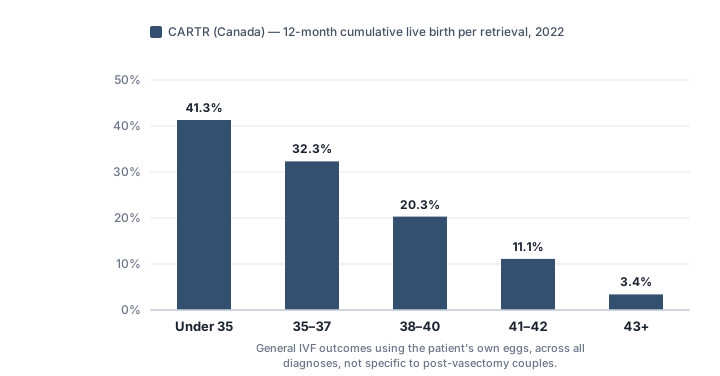
The US SART 2024 national summary reports a stricter metric, live birth with intended egg retrieval and first transfer, and therefore quotes lower numbers for the same age bands: 34.8%, 25.7%, 16.7%, 8.2% and 2.6%.8 Both sets of numbers tell the same story about the age gradient; they just count success differently. These are general IVF outcomes using the patient’s own eggs, across all diagnoses, not figures specific to couples using surgically retrieved sperm after vasectomy.
For a closer, age-matched picture, a 2018 retrospective series in older couples (female partner ≥35) reported pregnancy and live birth rates after reversal of 35% and 30%, which the authors found comparable to published age-specific IVF rates, though this was an indirect comparison rather than a head-to-head trial.9 A 2024 narrative review likewise concluded that pregnancy and live-birth rates do not clearly differ between reversal and surgical sperm retrieval with IVF/ICSI.1
The practical difference is that a successful reversal gives couples repeated opportunities to conceive naturally, over months to years for as long as the repair remains patent. Late failure (the repair narrowing or closing off after an initial success) does happen, most often within the first two years after a vasovasostomy. IVF, by contrast, proceeds in treatment episodes: one egg retrieval may yield several embryos and more than one transfer, and another retrieval is needed only if no usable embryos remain. That is why the registry figures above are counted per retrieval.
Time to pregnancy
IVF wins on speed. From stimulation to pregnancy test, a cycle takes about 6–8 weeks, and you know the result quickly. Reversal is a slower road: sperm usually return to the ejaculate within a few months, sooner after a vasovasostomy than after the more complex vasoepididymostomy,10 and natural pregnancy then takes many more months, often a year or more (about 16 months in one series).11 If your partner is 40 and the clock is loud, that difference can matter. If she is 32, has no known fertility concerns, and you have time, it usually matters less.
Cost: what couples actually pay in Canada
In most of Canada, vasectomy reversal is not publicly funded and IVF funding is limited. A few specifics worth knowing:
- Ontario funds one eligible IVF cycle per patient under 43 (Ontario Fertility Program details).
- Québec’s current program generally does not cover couples where one partner has undergone voluntary sterilisation such as vasectomy (Québec Medically Assisted Reproduction Program).
- Alberta does not publicly fund ART (AHCIP coverage). Some medications and diagnostic testing may be partly covered under provincial drug plans or private insurance.
- Public support varies widely and is changing: several provinces now fund a cycle or offer grants, rebates, or tax credits, including British Columbia, Manitoba, and Prince Edward Island, while others offer nothing. Confirm the current rules in your province.
- Vasectomy reversal is generally not publicly insured; Alberta explicitly lists it as an uninsured service.
As a rough guide for out-of-pocket costs in Canada in 2026:
- Vasectomy reversal: roughly $7,000–$20,000 CAD, typically as a one-time fee that covers the surgery, anaesthetic, and follow-up semen analyses.
- IVF with sperm retrieval: commonly about $15,000–$25,000 CAD or more per egg-retrieval cycle once medications, ICSI, and the retrieval are included, and some couples need more than one egg retrieval, particularly as the female partner’s age increases. Costs vary widely by clinic and medication protocol.
The multi-retrieval nature of IVF is important. A 2008 US decision-analytic model concluded that reversal was more cost-effective than either MESA or TESE with IVF/ICSI under all the assumptions it tested, once indirect costs such as multiple gestation and lost productivity were included.12 Absolute costs and IVF practice have changed since then, but a 2024 European review reached the same general conclusion, and it held even when the female partner was older.1
One more point on money. If a reversal gives you a second child a few years later without any additional procedure, the cost-per-child falls dramatically. IVF can sometimes do the same if frozen embryos remain, though that still means storage costs and another transfer.
Who carries the medical burden?
This is an underdiscussed part of the decision. In my practice, the man has a roughly two to three hour outpatient operation and returns to normal activity over the following few weeks. His partner has no ovarian stimulation or egg retrieval, though a fertility assessment may still be worthwhile. In IVF, the equation flips. The man has a relatively minor sperm retrieval, but the female partner shoulders most of the medical burden: weeks of self-administered injections, ovarian stimulation with its risks, egg retrieval under sedation, embryo transfer, and hormonal support afterwards. For many couples, especially when the female partner has no fertility issue of her own, this asymmetry is a meaningful factor.
When IVF is the right first choice
Reversal is not always the right answer. IVF with sperm retrieval is often preferred when:
- The female partner is older, particularly in her early 40s, and time is the dominant constraint.
- There is an independent female fertility factor (for example blocked fallopian tubes, or another condition for which her fertility specialist recommends IVF).
- A previous reversal has failed and repeat microsurgery is not favoured, or a vasoepididymostomy carries a poor prognosis.
- The couple needs IVF to use embryo genetic testing (PGT-M) for a known single-gene condition in the family.
- The obstructive interval is very long (commonly over 15–20 years) and the female partner is older, reducing the window to try naturally.
In several of these scenarios, a combined strategy of reversal with simultaneous sperm retrieval and cryopreservation as a backup plan can give couples the best of both worlds. Evidence suggests this combined approach is more cost-effective than IVF alone, even for older female partners.1 This combined approach requires a centre that performs sperm retrieval and cryopreservation at the time of the reversal. We do not offer retrieval at our facility; if this option appeals to you, it is worth raising at your consultation so the right referral can be made before choosing where to have surgery.
When reversal is the right first choice
For many couples, reversal is a strong first step when:
- The female partner has no known fertility concerns, and her age, menstrual history, and any clinically indicated fertility assessment are reassuring.
- The obstructive interval is under 10–15 years.2
- You are open to more than one child. A patent reversal gives you the possibility of several natural pregnancies from a single procedure.
- You would prefer to minimise the medical burden on your partner.
- Cost and long-term value are priorities.112
- You have a philosophical or personal preference for natural conception.
How to think about the decision
Rather than a universal rule, a post-vasectomy couple should be counselled about both reconstruction and sperm retrieval with IVF, with a workup of both partners before committing to a path. Current infertility guidance stresses that male and female factors be assessed concurrently, not sequentially. Four questions are useful to frame the conversation:
- What does the female partner’s fertility workup show? This includes her age (the single strongest factor), her menstrual and reproductive history, tubal status where clinically indicated, and any testing her clinician recommends. Ovarian reserve tests such as AMH help predict response to IVF stimulation, not the chance of natural conception. A reassuring workup widens the window for reversal; findings such as blocked tubes, or another condition for which a fertility specialist recommends IVF, may tilt the decision toward IVF regardless of the male factor.
- How long since the vasectomy? Shorter intervals carry higher patency and pregnancy rates, but this is a gradient, not a threshold: many couples still succeed at 15 or 20 years, and intraoperative findings and the partner’s age matter as much as the interval itself.2
- How much time do you have? An age-sensitive partner, a demanding career window, or a need to act quickly may shift the balance toward IVF or toward a combined reversal-with-cryopreservation approach (by referral).
- How many children do you want? Wanting one child may lean slightly toward IVF on speed, while wanting more than one may favour reversal on cost and simplicity. These are considerations, not rules.
None of these questions has a universal “right” answer. They exist to make the trade-offs explicit so the couple can decide together with their clinicians.
The bottom line
Vasectomy reversal and IVF with sperm retrieval are both effective, evidence-based routes to a baby after vasectomy. For many couples, particularly those with a reassuring female-partner workup and no independent female-factor infertility, microsurgical reversal is highly cost-effective and, in appropriately selected couples, has produced live-birth rates in the same general range as published IVF outcomes, while placing the procedural burden mainly on the man rather than his partner.1912 IVF has real advantages in specific situations, most notably advanced maternal age, time pressure, and coexisting female-factor infertility.
The most valuable thing you can do before choosing is to have both conversations: with a microsurgeon who does reversals regularly, and with a reproductive endocrinologist who does IVF. The numbers in this article are averages; your own numbers depend on your age, your partner’s age and workup, your obstructive interval, and your broader health.
Booking a consultation. Your initial consultation at Vas-Reversal.ca with Dr. Lombaard is complimentary. We'll review your individual situation, give you a realistic estimate of your own chances, and help you think through whether reversal or IVF makes more sense for your family.
Primary sources retrieved via PubMed and the CARTR-BORN / SART registries. This article is intended for general information and is not a substitute for individual medical advice. Costs and insurance coverage are indicative and vary by province, clinic, and individual circumstances. Please confirm with your providers directly.
-
Soave A, Kliesch S, Cremers JF. [Desire to have children after vasectomy: Vasectomy reversal or assisted reproductive technology?]. Urologie. 2024;63(11):1111–1121. doi: 10.1007/s00120-024-02454-9 (PMID: 39414715) ↩︎ ↩︎ ↩︎ ↩︎ ↩︎ ↩︎
-
Herrel LA, Goodman M, Goldstein M, Hsiao W. Outcomes of microsurgical vasovasostomy for vasectomy reversal: a meta-analysis and systematic review. Urology. 2015;85(4):819–825. doi: 10.1016/j.urology.2014.12.023 (PMID: 25817104) ↩︎ ↩︎ ↩︎ ↩︎ ↩︎
-
Namekawa T, Imamoto T, Kato M, Komiya A, Ichikawa T. Vasovasostomy and vasoepididymostomy: Review of the procedures, outcomes, and predictors of patency and pregnancy over the last decade. Reprod Med Biol. 2018;17(4):343–355. doi: 10.1002/rmb2.12207 (PMID: 30377390) ↩︎
-
Huyghe E, Faix A, Methorst C. Surgery to improve male fertility. Prog Urol. 2023;33(13):681–696. doi: 10.1016/j.purol.2023.09.011 (PMID: 38012911) ↩︎
-
Jee SH, Hong YK. One-layer vasovasostomy: microsurgical versus loupe-assisted. Fertil Steril. 2010;94(6):2308–2311. doi: 10.1016/j.fertnstert.2009.12.013 (PMID: 20074726) ↩︎
-
Ostrowski KA, Polackwich AS, Kent J, Conlin MJ, Hedges JC, Fuchs EF. Higher outcomes of vasectomy reversal in men with the same female partner as before vasectomy. J Urol. 2015;193(1):245–247. doi: 10.1016/j.juro.2014.07.106 (PMID: 25088953) ↩︎
-
Canadian Fertility and Andrology Society (CFAS). CARTR Plus Annual Report 2025. 12-month cumulative live birth rate per retrieval; figures cited are for the 2022 retrieval cohort as reported in the by-year table. Available at: cfas.ca/Library/CARTR/2025_CARTR_annual_report_CFAS_2024_Data.pdf ↩︎
-
Society for Assisted Reproductive Technology (SART). 2024 National Summary Report. Live birth per intended egg retrieval and per first embryo transfer. Available at: sartcorsonline.com ↩︎
-
Kapadia AA, Anthony M, Martinez Acevedo A, Fuchs EF, Hedges JC, Ostrowski KA. Reconsidering vasectomy reversal over assisted reproduction in older couples. Fertil Steril. 2018;109(6):1020–1024. doi: 10.1016/j.fertnstert.2018.02.118 (PMID: 29935639) ↩︎ ↩︎
-
Farber NJ, Flannigan R, Li P, Li PS, Goldstein M. The kinetics of sperm return and late failure following vasovasostomy or vasoepididymostomy: a systematic review. J Urol. 2019;201(2):241–250. doi: 10.1016/j.juro.2018.07.092 (PMID: 30130545) ↩︎
-
Uvin V, De Brucker S, De Brucker M, Vloeberghs V, Drakopoulos P, Santos-Ribeiro S, Tournaye H. Pregnancy after vasectomy: surgical reversal or assisted reproduction? Hum Reprod. 2018;33(7):1218–1227. doi: 10.1093/humrep/dey101 (PMID: 29788389) ↩︎
-
Lee R, Li PS, Goldstein M, Tanrikut C, Schattman G, Schlegel PN. A decision analysis of treatments for obstructive azoospermia. Hum Reprod. 2008;23(9):2043–2049. doi: 10.1093/humrep/den200 (PMID: 18556680) ↩︎ ↩︎ ↩︎
Questions about your reversal options?
Your initial consultation with Dr. Lombaard is free.
Book a Free Consultation